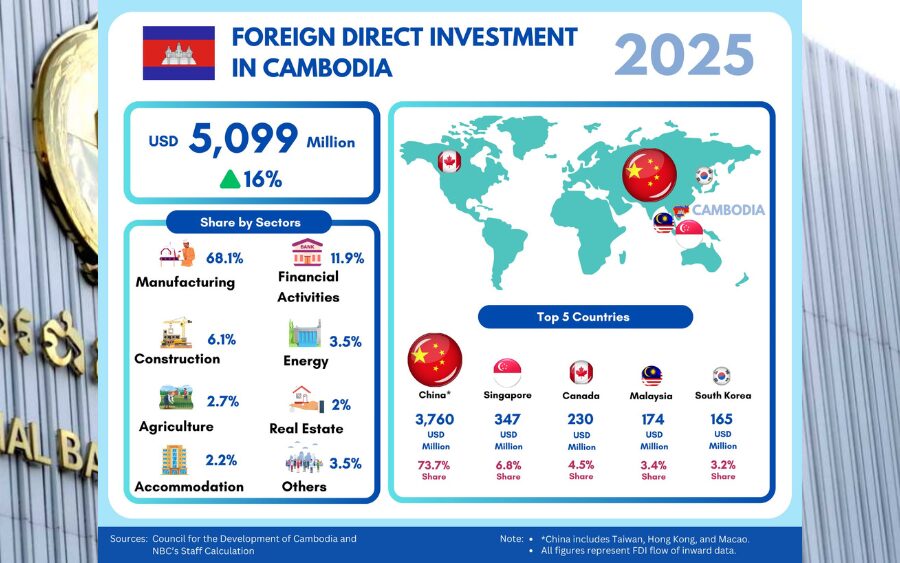
Foreign Direct Investment (FDI) continues to play a crucial role in Cambodia’s economic development. In 2025, Cambodia experienced strong growth in investment inflows, driven by increasing confidence from international investors, expanding trade agreements, and the country’s stable macroeconomic environment.
Overview of FDI in Cambodia in 2025
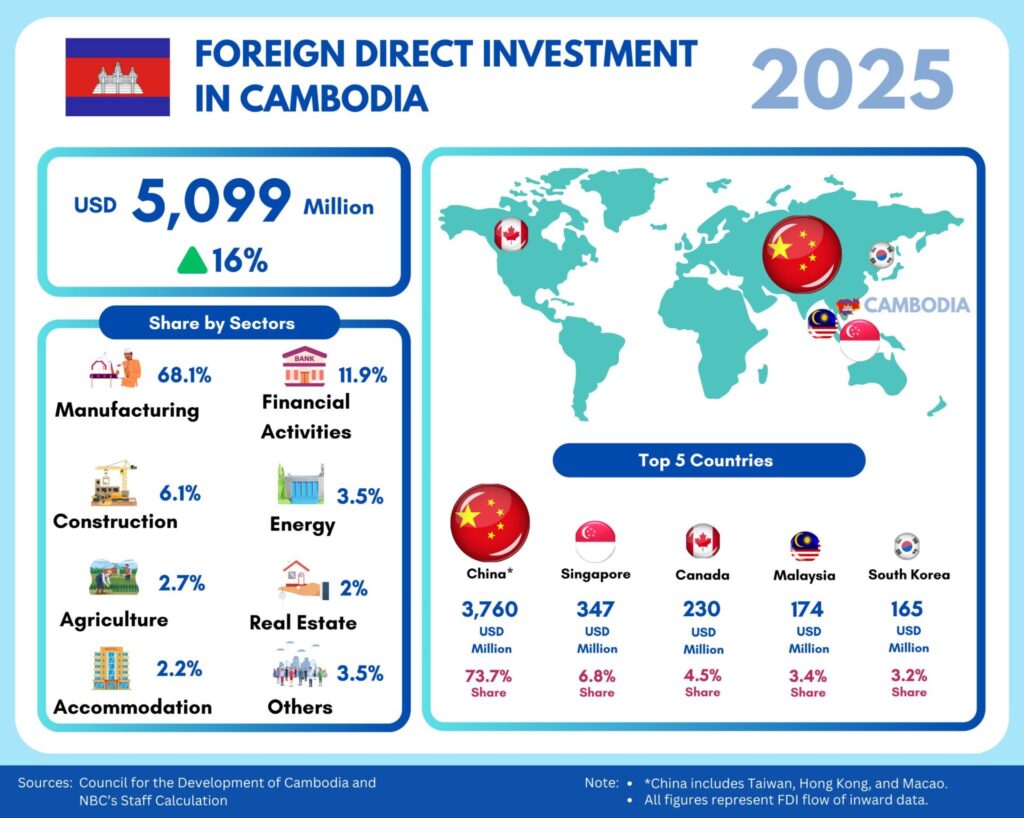
In 2025, Cambodia attracted approximately USD 5,099 million (USD 5.1 billion) in foreign direct investment, representing a 16% increase compared to the previous year. This growth reflects the country’s improving investment climate and its strategic position within Southeast Asia’s manufacturing and supply chains.
Overall investment activity in the country has been expanding rapidly. According to the Council for the Development of Cambodia (CDC), Cambodia approved hundreds of investment projects in 2025 with total capital reaching around USD 10 billion, generating hundreds of thousands of jobs and contributing significantly to economic growth.
The expansion of investment projects demonstrates Cambodia’s attractiveness as a destination for global investors seeking cost-competitive production locations and access to regional markets.
FDI Distribution by Sector
The majority of foreign investment in Cambodia is concentrated in a few key sectors:
- – Manufacturing – 68.1%
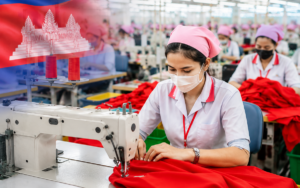
Manufacturing is the largest recipient of FDI. Investments mainly focus on garment production, electronics assembly, and other export-oriented industries. Cambodia’s competitive labor costs and trade preferences make the sector highly attractive. - – Financial Activities – 11.9%
Banks, financial institutions, and fintech services continue to expand, supporting Cambodia’s growing economy. - – Construction – 6.1%
Investment in infrastructure, residential developments, and commercial projects contributes to the expansion of urban areas. - – Energy – 3.5%
Investments include power plants and renewable energy projects supporting Cambodia’s increasing energy demand. - – Agriculture – 2.7%
Agricultural and agro-processing investments help strengthen food production and export capacity. - – Real Estate – 2%
Foreign capital is also invested in property development and housing projects. - – Accommodation – 2.2%
Tourism growth continues to encourage investment in hotels and hospitality services. - – Other sectors – 3.5%
Manufacturing alone accounts for the majority of new capital inflows, highlighting Cambodia’s role as an emerging manufacturing hub in the region.
Top Countries Investing in Cambodia
Foreign investment in Cambodia comes primarily from Asian partners and a few Western countries. The top five sources of FDI in 2025 include:
| Country | Investment (USD Million) | Share |
|---|---|---|
| China | 3,760 | 73.7% |
| Singapore | 347 | 6.8% |
| Canada | 230 | 4.5% |
| Malaysia | 174 | 3.4% |
| South Korea | 165 | 3.2% |
Among these investors, China remains the largest source of foreign investment, accounting for nearly half of Cambodia’s total investment inflows in recent years.
Chinese investment is often concentrated in infrastructure, manufacturing, and large-scale development projects, while Singapore, South Korea, and Malaysia focus more on finance, technology, and industrial development.
Source: National Bank of Cambodia (NBC)




1 thought on “Foreign Direct Investment (FDI) in Cambodia – 2025”
Comments are closed.