Cambodia has increasingly positioned itself as an open and trade-friendly economy by actively engaging in Free Trade Agreements (FTAs) with both regional and global partners. These agreements play a crucial role in boosting exports, attracting foreign investment, and integrating Cambodia into global value chains. Over the past decade, Cambodia’s participation in major FTAs has significantly shaped its economic trajectory.
Understanding FTAs and Why They Matter for Cambodia
Free Trade Agreements are arrangements between countries to reduce or eliminate trade barriers such as tariffs, quotas, and regulatory restrictions. For Cambodia, FTAs are particularly important because they:
- – Improve market access for Cambodian goods
- – Enhance competitiveness of key industries like garments, agriculture, and manufacturing
- – Attract foreign direct investment (FDI)
- – Support long-term economic growth and diversification
As a developing economy, Cambodia benefits from preferential treatment under many agreements, allowing its exports to enter foreign markets at lower or zero tariffs.
Cambodia’s Regional Trade Agreements
1. ASEAN Free Trade Area (AFTA)
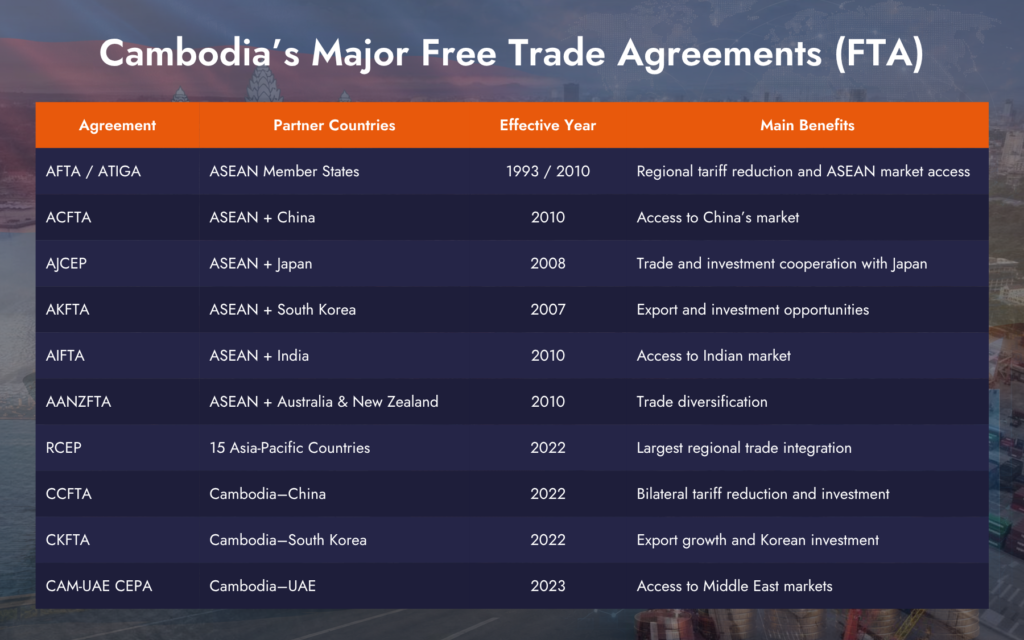
As a member of the Association of Southeast Asian Nations (ASEAN), Cambodia participates in the ASEAN Trade in Goods Agreement (ATIGA). This agreement enables:
- – Near-zero tariffs among ASEAN countries
- – Easier movement of goods across Southeast Asia
This regional integration is a foundation for Cambodia’s trade, connecting it with fast-growing neighbors such as Thailand, Vietnam, and Singapore.
2. ASEAN “Plus” FTAs
Beyond intra-ASEAN trade, Cambodia benefits from ASEAN’s FTAs with major global economies, including:
- – China
- – Japan
- – South Korea
- – India
- – Australia and New Zealand
These agreements expand Cambodia’s access to some of the world’s largest markets and strengthen its role in regional supply chains.
The Regional Comprehensive Economic Partnership (RCEP)
One of the most significant agreements Cambodia has joined is the Regional Comprehensive Economic Partnership (RCEP).
- – Came into effect: 2022
- – Members: 15 countries, including ASEAN nations plus China, Japan, South Korea, Australia, and New Zealand
- – Covers about 30% of global GDP and population
RCEP simplifies trade rules and reduces tariffs across a massive economic bloc. For Cambodia, it means:
- – Greater export opportunities
- – Stronger regional supply chain integration
- – Increased trade with key partners like China, Japan, and Thailand
Since its implementation, Cambodia’s trade with RCEP countries has grown steadily, highlighting its importance to the country’s economic future.
Cambodia’s Bilateral Free Trade Agreements
1. Cambodia–China Free Trade Agreement (CCFTA)
The Cambodia–China FTA, effective since 2022, is one of Cambodia’s most impactful bilateral agreements.
Key benefits include:
- – Preferential access to China’s massive consumer market
- – Reduced tariffs on agricultural and industrial products
- – Increased exports of rice, bananas, and other agricultural goods
The agreement complements RCEP and provides Cambodia with even more favorable conditions in the Chinese market.
2. Cambodia–South Korea Free Trade Agreement (CKFTA)
Cambodia also signed an FTA with South Korea, expanding opportunities for:
- – Cambodian exports such as garments and agricultural products
- – Korean investment in manufacturing and infrastructure
This agreement strengthens Cambodia’s economic ties with one of Asia’s leading economies.
3. Emerging and New Trade Frameworks
As part of its long-term trade strategy, Cambodia continues to pursue new economic partnerships beyond its traditional markets.
One notable milestone is the Cambodia–United Arab Emirates Comprehensive Economic Partnership Agreement (CAM-UAE CEPA), signed in 2023. This agreement opens new opportunities for Cambodian exports to the Middle East while strengthening cooperation in investment and economic development.
Cambodia is also exploring additional trade partnerships with other countries to further diversify its export destinations and enhance economic resilience.
Impact of FTAs on Cambodia’s Economy
Cambodia’s FTAs have had a noticeable impact on its economic development:
1. Export Growth: FTAs have boosted exports of garments, footwear, bicycles, and agricultural products. Preferential tariffs make Cambodian goods more competitive globally.
2. Investment Attraction: Lower trade barriers encourage foreign companies to invest in Cambodia as a production base for regional and global markets.
3. Economic Diversification: While garments remain dominant, FTAs support growth in new sectors such as electronics, agro-processing, and logistics.
4. Integration into Global Supply Chains: Cambodia is becoming more connected to regional manufacturing networks, especially within Asia.
Sources
- Ministry of Commerce of Cambodia (MoC)
Official information on Cambodia’s trade policies, Free Trade Agreements, and trade statistics.
Ministry of Commerce of Cambodia - General Department of Customs and Excise of Cambodia (GDCE)
Information on customs procedures, tariffs, and implementation of trade agreements.
General Department of Customs and Excise of Cambodia - ASEAN Secretariat
Official information on the ASEAN Free Trade Area (AFTA), ASEAN Trade in Goods Agreement (ATIGA), and ASEAN Plus FTAs.
ASEAN Secretariat - RCEP Secretariat
Official information on the Regional Comprehensive Economic Partnership (RCEP), including member countries and agreement details.
RCEP Secretariat - World Trade Organization (WTO)
Cambodia’s trade policy reviews, trade profiles, and WTO membership information.
World Trade Organization (WTO) - International Trade Centre (ITC)
Trade statistics, export opportunities, and market access information for Cambodia.
International Trade Centre (ITC)