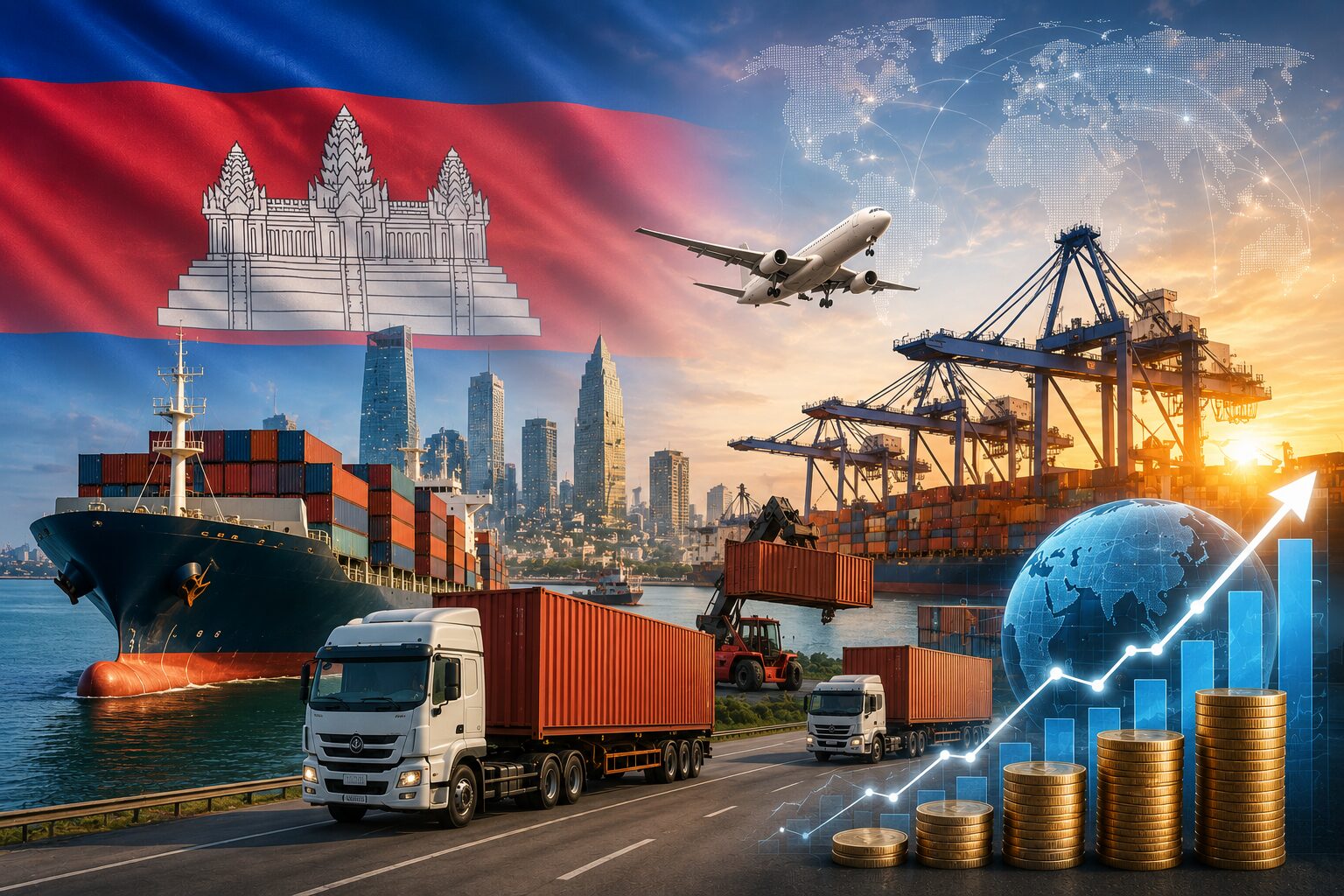
Cambodia’s international trade continued its strong upward momentum during the first half (Semester 1) of 2026, reflecting the country’s expanding role in regional and global supply chains. According to the General Department of Customs and Excise of Cambodia (GDCE), total merchandise trade reached US$38.22 billion between January and June 2026, representing a 23% increase compared to US$31.01 billion during the same period in 2025.
The impressive growth was driven by rising exports, increasing imports of industrial inputs, and stronger trade relationships with Cambodia’s major economic partners. Continued implementation of regional and bilateral free trade agreements, together with increasing foreign direct investment, has further strengthened Cambodia’s position as one of Southeast Asia’s emerging trading economies.
Cambodia’s Trade Performance in Semester 1 of 2026
During the first six months of 2026, Cambodia exported goods worth US$17.36 billion, an increase of 18% year-on-year, while imports rose by 28% to US$20.86 billion. As a result, Cambodia recorded a trade deficit of US$3.51 billion, largely reflecting higher imports of machinery, raw materials, petroleum products, and industrial equipment that support domestic production and export-oriented manufacturing.
| Indicator | S1 2026 | YoY Growth |
|---|---|---|
| Total Trade Volume | US$38.22 B | +23% |
| Exports | US$17.36 B | +18% |
| Imports | US$20.86 B | +28% |
| Trade Balance | -US$3.51 B | Trade Deficit |
Despite the trade deficit, the strong increase in imports is widely viewed as a positive sign of expanding industrial activity and business investment, particularly in Cambodia’s manufacturing and construction sectors.
China and the United States Remain Cambodia’s Largest Trading Partners
China continued to maintain its position as Cambodia’s largest trading partner during Semester 1 of 2026, with total bilateral trade reaching US$11.64 billion, an increase of 25% compared to the previous year. Cambodia imported more than US$10.69 billion worth of goods from China, primarily machinery, industrial equipment, textiles, electronics, construction materials, and manufacturing inputs.
Meanwhile, the United States remained Cambodia’s largest export market, with Cambodian exports totaling US$7.17 billion. The country recorded a trade surplus of approximately US$6.87 billion with the U.S., largely driven by exports of garments, footwear, travel goods, furniture, bicycles, and other manufactured products.
Trade with neighboring Viet Nam also continued to expand, reaching nearly US$4.20 billion, highlighting the importance of regional supply chains and cross-border commerce. Thailand and Japan remained among Cambodia’s key trading partners, supporting trade in agricultural products, industrial materials, automotive components, and consumer goods.
Cambodia’s Top 10 Trading Partners (Semester 1 2026)
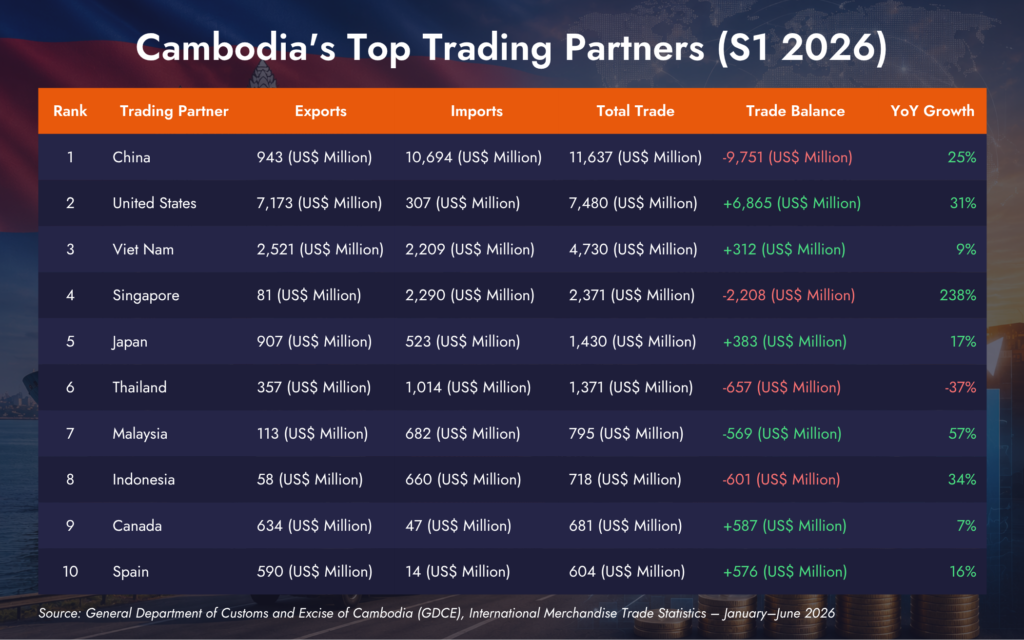
Cambodia Records Strong Trade Surpluses with Western Markets
Cambodia continued to generate significant trade surpluses with several major developed economies. The United States remained the country’s largest surplus market, followed by Canada, Spain, the Netherlands, the United Kingdom, Japan, Germany, Viet Nam, Australia, and Belgium.
These positive trade balances reflect Cambodia’s strong competitiveness in export-oriented industries such as garments, footwear, travel goods, bicycles, furniture, and agricultural products. Demand from North American and European markets continues to play a crucial role in supporting Cambodia’s export growth and employment.
Trade Deficits Reflect Industrial Development
Cambodia’s largest trade deficits were recorded with China, Singapore, Thailand, Indonesia, Malaysia, Taiwan, the Republic of Korea, Lao PDR, Finland, and India.
Rather than indicating economic weakness, these deficits largely result from Cambodia’s reliance on imported machinery, industrial raw materials, electronics, fuel, and intermediate goods used in domestic manufacturing and infrastructure development. Many of these imports are processed or assembled in Cambodia before being exported to international markets, making them an essential component of the country’s export-driven economy.
Outlook for Cambodia’s Trade
The strong performance recorded during the first half of 2026 demonstrates Cambodia’s continued economic resilience despite ongoing global uncertainties. Growing foreign investment, improved logistics infrastructure, and the implementation of trade agreements such as the Regional Comprehensive Economic Partnership (RCEP) and the Cambodia–China Free Trade Agreement (CCFTA) are expected to support further growth throughout the remainder of the year.
As Cambodia continues to diversify its export markets and strengthen regional connectivity, international trade is expected to remain one of the country’s primary engines of economic development.
Source
Official statistics are sourced from the General Department of Customs and Excise of Cambodia (GDCE):
- GDCE Press Release – International Merchandise Trade Statistics (Semester 1, 2026): https://stats.customs.gov.kh/en/press-release
- GDCE Trade Statistics Portal: https://stats.customs.gov.kh/