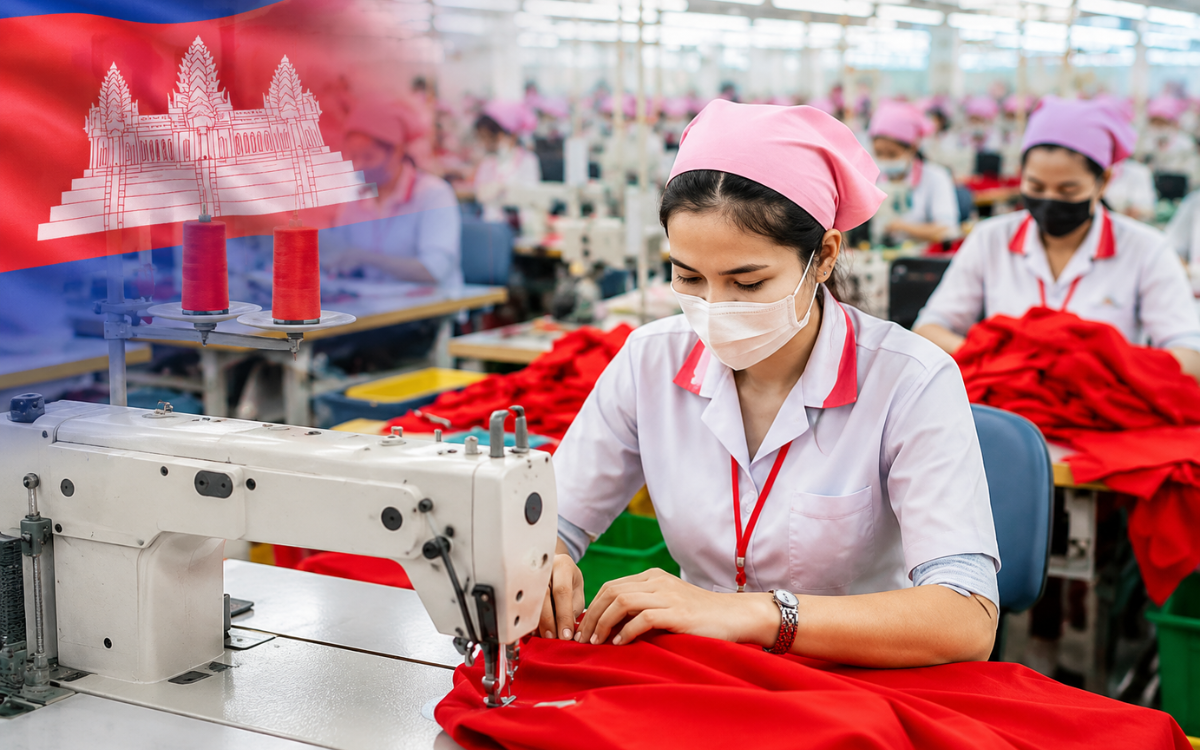
Cambodia’s industrial sector serves as a cornerstone of the nation’s economic development, powering structural transformation, job creation, and export diversification. Aligned with the Royal Government of Cambodia’s Pentagonal Strategy – Phase I and the Cambodia Industrial Development Policy (IDP), the industrial landscape has demonstrated strong resilience and sustained expansion across key industrial hubs and manufacturing sub-sectors.
Core Highlights at a Glance:
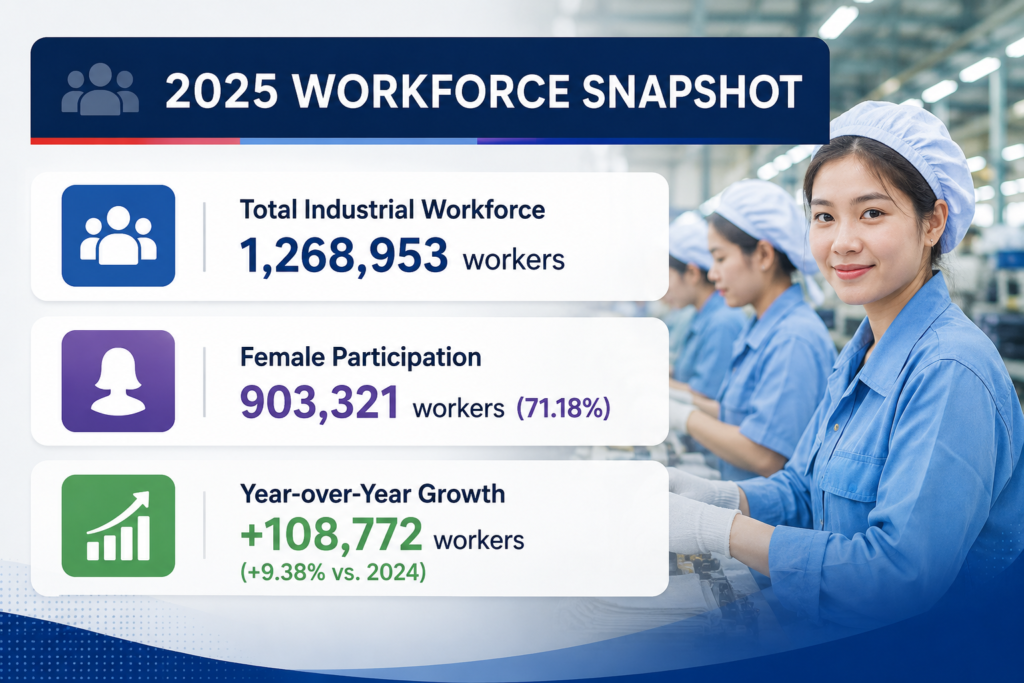
- – Total Workforce Reaches New Peak: The industrial labor force expanded to 1,268,953 workers in 2025, adding 108,772 net new jobs (+9.38% growth compared to 2024).
- – Strong Female Inclusion: Women constitute 71.18% (903,321 workers) of the overall workforce, continuing to drive household income stability and poverty reduction across rural and semi-urban communities.
- – Geographic Hubs: Phnom Penh, Kampong Speu, and Kandal lead as the top three industrial centers, collectively employing over 865,000 workers.
- – Pillar Sub-Sectors: Garment Manufacturing (684,394 workers) and Footwear Manufacturing (333,220 workers) remain the dominant industries, combined accounting for over 80% of total sector employment.
- – Diversification Momentum: Emerging segments such as Rubber & Plastics (51,101 workers) and Electrical & Electronics (31,950 workers) are showing steady gains in workforce absorption.
1. Key Workforce Indicators & Demographic Highlights
In 2025, formal employment across Cambodia’s industrial sector reached historic levels, characterized by high growth and significant female labor force participation.
Key Insights:
- – Empowering the Female Workforce: Women constitute 71.18% (903,321 workers) of the industrial workforce. Female labor force participation remains essential to family income stability and poverty reduction across semi-urban and rural communities.
- – Strong Net Job Creation: The sector added 108,772 net new jobs in 2025, representing a 9.38% expansion compared to the 1,160,181 total recorded in 2024.
- – Investor Confidence: The steady growth reflects sustained Foreign Direct Investment (FDI) inflows, simplified administrative procedures, and favorable trade preferences with major international export markets.
2. Multi-Year Trends & Structural Resilience (2021 – 2025)
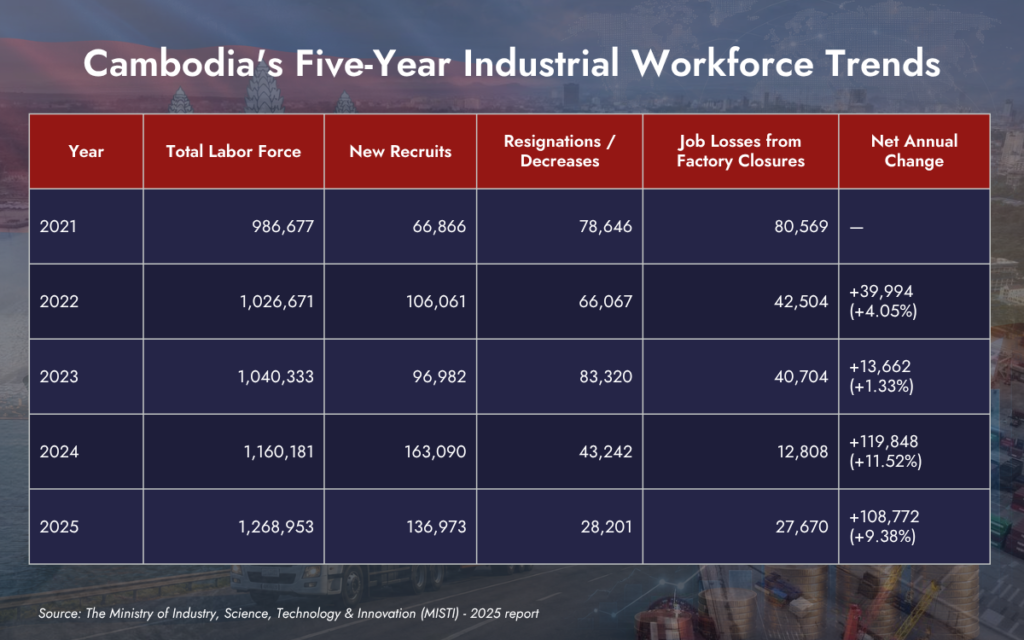
Over the past five years, Cambodia’s industrial sector navigated post-pandemic recovery and global economic fluctuations to build consistent upward momentum.
Analysis of Multi-Year Dynamics:
- – Post-Pandemic Realignment (2021–2022): In 2021, global supply chain disruptions caused elevated factory closures (80,569 job losses). However, sharp recruitment spikes in 2022 (106,061 new hires) restored momentum above the 1-million mark.
- – Stabilization & Peak Hiring (2024–2025): Factory closure losses plummeted from over 80,000 in 2021 down to 12,808 in 2024 and 27,670 in 2025. Concurrently, high recruitment numbers (163,090 in 2024 and 136,973 in 2025) pushed total employment past 1.26 million.
3. Geographic Distribution Across Capital & Provinces
Industrial employment in Cambodia displays distinct clustering around key infrastructure corridors, urban markets, and Special Economic Zones (SEZs) near sea ports and border crossings.
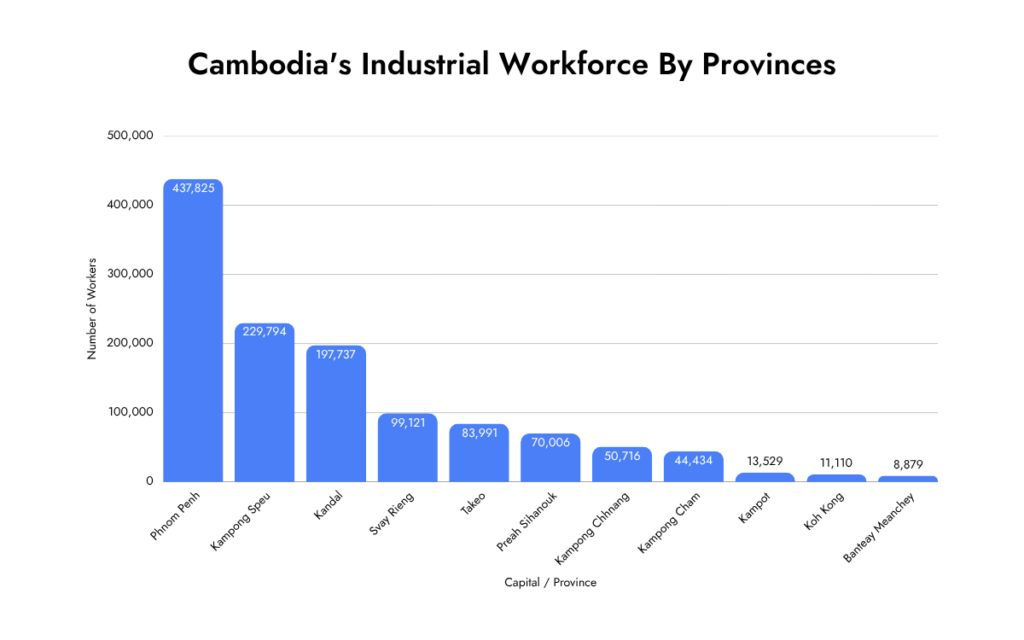
Regional Economic Hubs Breakdown:
1. The Greater Phnom Penh Economic Zone:
- – Phnom Penh: 437,825 workers — Remains the central industrial engine, hosting high concentrations of garment factories, logistics hubs, and processing facilities.
- – Kampong Speu: 229,794 workers — Emerged as the second-largest employer due to major highway infrastructure investments (National Roads 3 and 4) attracting light manufacturing expansion.
- – Kandal: 197,737 workers — Functions as a primary industrial satellite surrounding the capital city.
2. Border Economic & Trade Zones:
- – Svay Rieng: 99,121 workers — Driven by vibrant Special Economic Zones (Bavet SEZs) leveraging cross-border trade and supply chains with Vietnam.
- – Takeo: 83,991 workers — Benefiting from growing connectivity to deep-water ports and southern trade lines.
3. Coastal & Logistics Centers:
- – Preah Sihanouk: 70,006 workers — Centered on the Sihanoukville Special Economic Zone (SSEZ) and autonomous deep-sea port activities.
4. Central Agricultural-Industrial Corridors:
- – Kampong Chhnang: 50,716 workers
- – Kampong Cham: 44,434 workers
- – Remaining Provinces: Account for the balance of the nationwide total (1,268,953 workers).
4. Sectoral Breakdown Across Industry Categories
While traditional export industries (Apparel, Footwear, and Travel Goods) continue to anchor formal industrial hiring, Cambodia’s manufacturing landscape is progressively diversifying into higher-value assembly and specialized light manufacturing.
Detailed Sub-Sector Breakdown:
- – Garment Manufacturing: 684,394 workers — Represents the single largest segment (53.9% of total industrial workforce), remaining the premier driver of national export revenue.
- – Footwear Manufacturing: 333,220 workers — The second largest pillar (26.3% of total workforce), continuing to show robust global export demand.
- – Rubber & Plastic Products: 51,101 workers — Key input producer supporting consumer packaging, construction materials, and export goods.
- – Electrical & Electronics Equipment: 31,950 workers — High-growth, value-added sector aligned with national diversification goals to attract technical assembly investments.
- – Travel Goods & Bags: 29,397 workers — Important pillar supporting luggage and leather accessories manufacturing.
- – Food Processing & Products: 28,639 workers — Crucial for domestic value creation and agro-industrial transformation.
- – Textile & Fabric Production: 21,862 workers — Upstream textile production strengthening domestic vertical integration for garments.
- – Paper & Paper Products: 11,308 workers
- – Furniture Manufacturing: 11,212 workers
- – Chemical Products: 10,169 workers
Source
Ministry of Industry, Science, Technology & Innovation. (2026). Report on the work achievements of 2025 and direction for 2026 (p. 28–29). Royal Government of Cambodia. https://cdn.misti.gov.kh/documents/20260223010023LLv8zBirQEL8.pdf